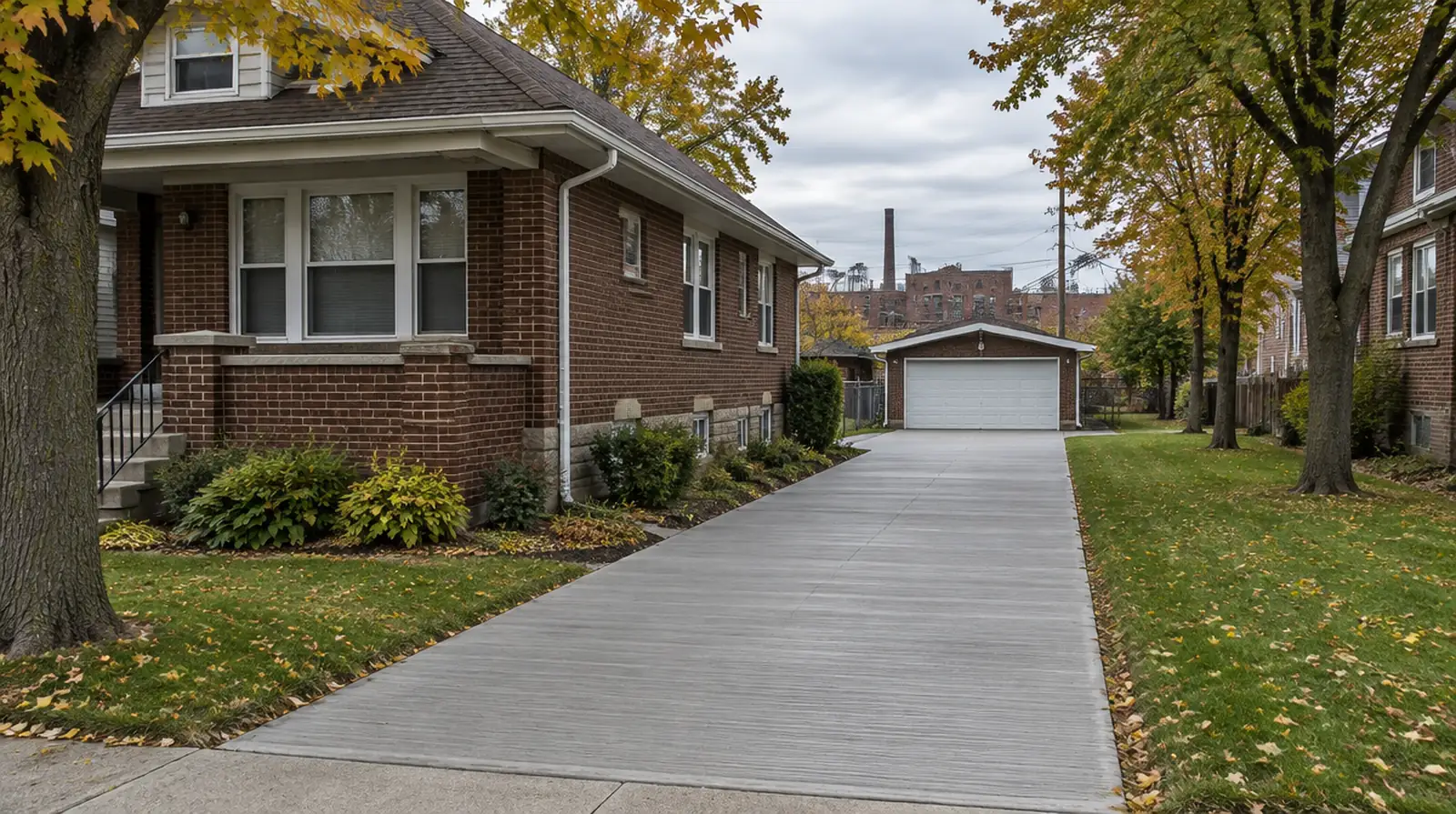
Driveways after years of salt
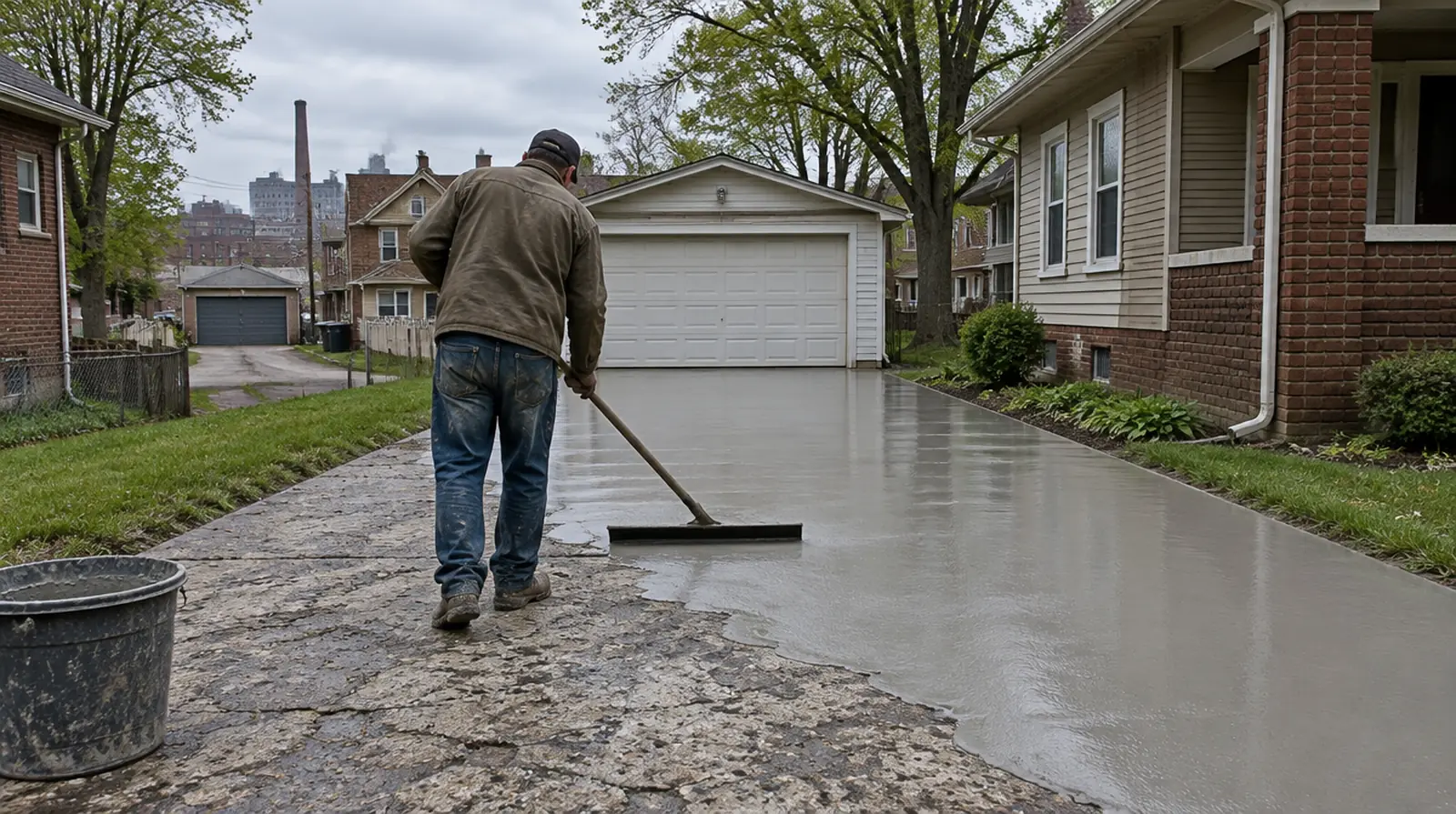
Many driveways here show the same pattern: the surface paste has flaked away, exposing rough aggregate, pitting and patches of scaling, often worst near the garage and street where salt and slush collect. Oil and rust stains add to the worn appearance. Replacement is costly and disruptive. If the slab is structurally sound, resurfacing restores a smooth, uniform surface at a fraction of the price.
What resurfacing involves
We pressure wash the driveway, remove stains, grind high spots and repair cracks and deeper spalls. A primer helps the overlay bond. Then we apply a polymer-modified cementitious resurfacer, spread evenly and finished with a broom or spray texture for traction. After curing, we apply a penetrating sealer to protect the new surface from salt.
Traction comes first
We do not install glossy coatings on driveways. In winter, smooth films become dangerously slippery with ice and slush. Textured cementitious overlays and penetrating sealers keep a natural grip.
Stain removal
Oil stains are degreased and, when deep, ground out so they do not bleed through the overlay. Rust stains from fertilizer or metal are treated with specialized cleaners. Tire marks lift with degreasers and rotary surface cleaners.
Cracks and joints
Cracks are routed and filled. Control joints are preserved through the overlay so the driveway can move naturally with temperature. Heaved or sunken sections may need lifting or replacement before resurfacing, and we will tell you when that is the case.
Aprons and walks
Garage aprons, public sidewalk sections, front walks and steps can be resurfaced at the same time for a consistent look. Steps receive careful edge work so nosings stay crisp.
Sealing afterward
A penetrating silane or siloxane sealer protects the resurfaced driveway. We recommend resealing every few years. See our sealing page for details.
When to schedule
Resurfacing requires warm, dry weather for proper cure, typically late spring through early fall. Booking early in the season ensures the work is complete and sealed before salt season.
Timeline
Most driveways take one to two days of work, with foot traffic after a day and vehicles after several days.
Cost
Size, repair needs, stain removal and access determine price. Resurfacing is typically much less expensive than replacement.
Care
Shovel promptly, use de-icers sparingly and avoid ammonium-based products. Rinse salt residue in spring and reseal on schedule.
How long resurfacing lasts
A properly bonded and sealed overlay lasts many years. Its life depends on the soundness of the original slab, drainage and how much salt it sees each winter.
Questions
Will an overlay peel? Not when the surface is properly prepared and primed.
Can you match my sidewalk color? Overlays come in standard gray and can be tinted.
Can a badly scaled driveway be saved? If structurally sound, usually yes.
Can I use rock salt afterward? Sparingly, with a sealed surface, though sand or gentler de-icers are better.
Questions homeowners ask about driveway coatings
Will it be slippery? Not when it is done right. We broadcast a fine grit into the topcoat so tires and boots grip in wet weather, and we can raise the texture near the apron where slush collects. Will hot tires lift it? Our driveway systems are breathable and UV stable, so they do not soften or peel the way cheap hardware store epoxies do in July sun.
How long until we can park? Foot traffic is usually fine the next morning. Vehicles wait about two to three days depending on temperature and humidity. We schedule around dry forecasts and tell you plainly if conditions push the date back a day.
What about existing cracks? Hairline cracks are filled and blended. Wider cracks or heaved sections get honest advice, because a coating cannot fix a slab that is still moving. Sometimes the right answer is to repair one panel first and coat later.
Fix my driveway
Call (219) 529-1796 for a free estimate.